
Outcomes
Program Outcomes
Our goal is to create a cadre of researchers who will have a productive impact on the biomedical research workforce by virtue of: the depth and breadth of their knowledge; their grasp of the rigorous practice of research; their skills in independently conceiving, conducting, and critically evaluating genetics research; their professional skills in communication, teaching/mentorship, and collaboration; their commitment to the ethical practice of science; and their ability to create a career path that reflects their interests and needs.
By the Numbers
• 5.6 years - Average time to a PhD degree
• 72 - Number of UGTP trainees over the past 15 years
• 94% - Trainees who completed their PhD or are still engaged in predoctoral training
• <3% - Trainees who left graduate school without a degree
Career Outcomes
The rigorous training in scientific practice and thinking, analyses, and communication provided by the UGTP helps prepare our trainees for a large variety of career trajectories. Of the 72 students who participated in the UGTP over the past 15 years, 22 are still conducting their pre-doctoral training. Our alumni have pursued continued training or established research careers in the academic, private research institute, clinical, and biotech sectors, in addition to careers in medicine, health, law, education and outreach.
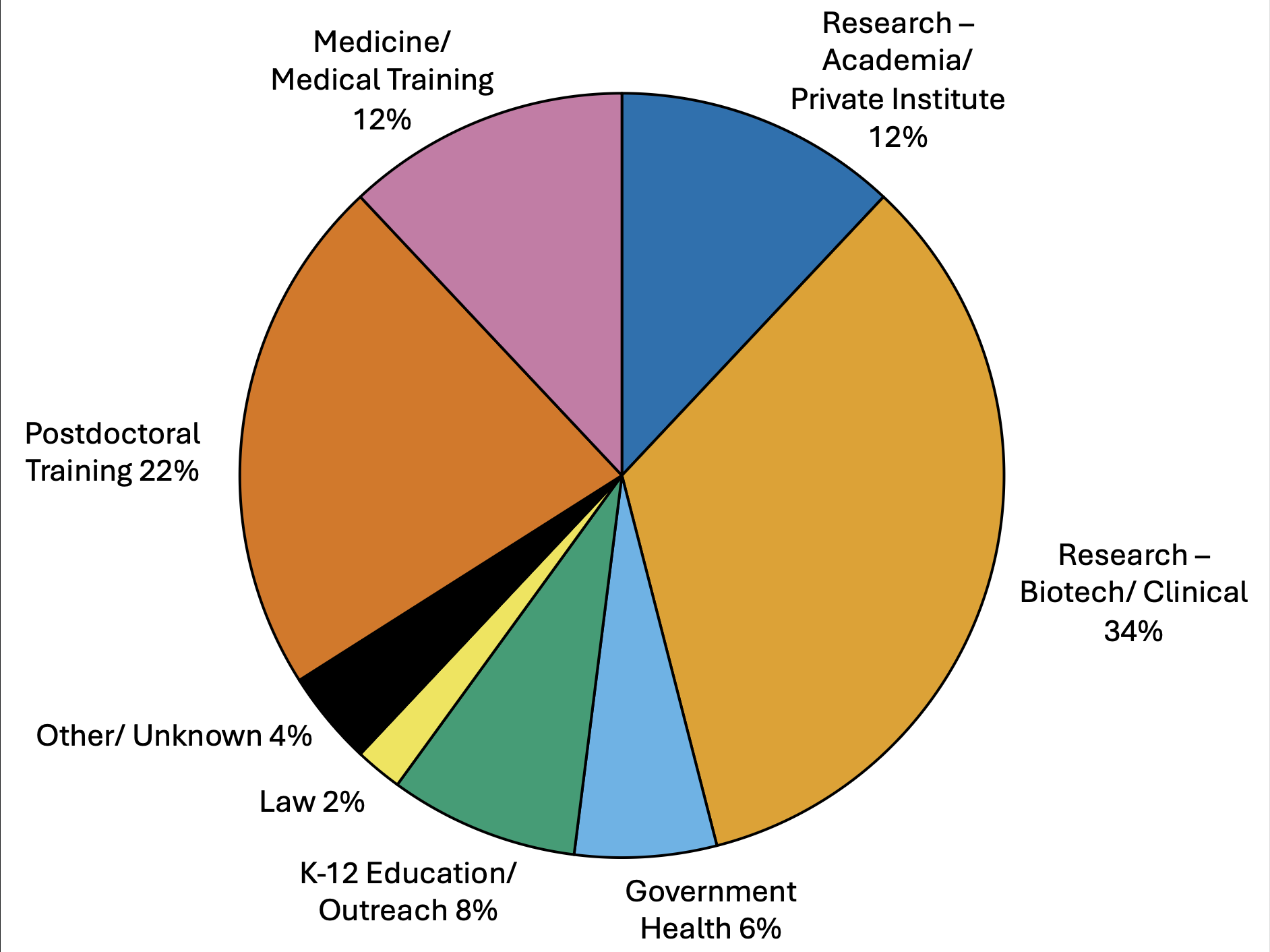
Career outcome data from program alumni with graduation dates 2011-2026 (updated Sept 2026).
Publications
Our trainees are responsible for ensuring the results of their scientific investigations are communicated, and all UGTP trainees publish as part of completion of their PhD work. We are especially proud of the quality of the contributions of our trainees.
Selected publications from the past five years (trainees underlined):
Carlson, N.J., Hastings, A.P., Duplais, C. & Agrawal, A.A. 2026. Divergent dietary and defensive adaptations of closely related coexisting seed bugs. Proc Natl Acad Sci U S A, 123, e2535697123. 10.1073/pnas.2535697123
Haffener, P.E., Al-Riyami, A.Z., Al-Zadjali, S., Busby, G.B.J., Al-Mahdhuri, S., Al-Rawahi, M., Al-Hosni, S., Al-Marhoobi, A., Al-Sheriyani, A. & Leffler, E.M. 2026. Adaptive admixture at ACKR1, the Duffy blood group locus, may have shaped Plasmodium vivax prevalence in Oman. Am J Hum Genet, 113, 767-781. 10.1016/j.ajhg.2026.02.023
Scholz, P., Thompson, J., Crosby, K.T., Fauth, T., Krah, N.M., Schlauderaff, G., Back, R., Berkheimer, Z.A., Jolley, A., Sombroek, D., Medert, R., Zurek, C., Dmytrenko, O., Wilson, E., Schut, F.T., Rutter, J., Zhang, X., Krohn, M., Jackson, R.N., Beisel, C.L. & Liu, Y. 2026. RNA-triggered cell killing with CRISPR-Cas12a2. Nature, 655, 230-239. 10.1038/s41586-026-10466-y
Carlson, N., Jurmu, J.D. & Dearing, M.D. 2026. Gut microbes compensate for protein-deficient diets. Trends Microbiol, 34, 697-699. 10.1016/j.tim.2026.05.013
Park, Y.J., Liu, C., Lee, J., Brown, J.T., Ma, C.B., Liu, P., Gen, R., Xiong, Q., Zepeda, S.K., Stewart, C., Addetia, A., Craig, C.J., Tortorici, M.A., Alshukairi, A.N., Starr, T.N., Yan, H. & Veesler, D. 2025. Molecular basis of convergent evolution of ACE2 receptor utilization among HKU5 coronaviruses. Cell, 188, 1711-1728 e21. 10.1016/j.cell.2024.12.032
Li, W., Scheel, T. & Shen, P.S. 2025. Mechanism of nascent chain removal by the ribosome-associated quality control complex. Nat Commun, 16, 5792. 10.1038/s41467-025-61235-w
Klure, D.M., Greenhalgh, R., Orr, T.J., Shapiro, M.D. & Dearing, M.D. 2025. Parallel gene expansions drive rapid dietary adaptation in herbivorous woodrats. Science, 387, 156-162. 10.1126/science.adp7978
Gillis, K., Orellana, W.A., Wilson, E., Parnell, T.J., Fort, G., Fang, P., Essel Dadzie, H., Murphy, B.M., Zhang, X. & Snyder, E.L. 2025. FoxA1/2-dependent epigenomic reprogramming drives lineage switching in lung adenocarcinoma. Dev Cell, 60, 472-489 e8. 10.1016/j.devcel.2024.10.009
Haffener, P.E., Hopson, H.D., Herbert-Mainero, A., Ramirez, A. & Leffler, E.M. 2025. Phylogenetics and genomic variation of Hepatocystis isolated from shotgun sequencing of wild primate hosts. PLoS Pathog, 21, e1013240. 10.1371/journal.ppat.1013240
Fort, G., Arnold, H., Camolotto, S.A., O'toole, K., Tariq, R., Waters, A., Gillis, K. & Snyder, E.L. 2025. Opposing lineage specifiers induce a protumor hybrid identity state in lung adenocarcinoma. Genes Dev, 39, 1081-1105. 10.1101/gad.352742.125
Bervoets, S., Jacob, M.S., Devineni, A.V., Mahoney, B.D., Sullivan, K.R., Butts, A.R., Sung, H., Einstein, J., Metzstein, M.M., Dus, M., Shepherd, J.D. & Caron, S.J.C. 2025. dArc1 controls sugar reward valuation in Drosophila melanogaster. Curr Biol, 35, 4188-4198 e7. 10.1016/j.cub.2025.07.048
Aderounmu, A.M., Maus-Conn, J., Consalvo, C.D., Shen, P.S. & Bass, B.L. 2025. Biochemical and structural basis of Dicer helicase function unveiled by resurrecting ancient proteins. Proc Natl Acad Sci U S A,122, e2500825122. 10.1073/pnas.2500825122
Bladen, J., Cooper, J.C., Ridges, J.T., Guo, P. & Phadnis, N. 2024. A new hybrid incompatibility locus between Drosophila melanogaster and Drosophila sechellia. Genetics, 226. 10.1093/genetics/iyae001
Bladen, J., Nam, H.J. & Phadnis, N. 2024. Transformation of meiotic drive into hybrid sterility in Drosophila. Genetics, 228. 10.1093/genetics/iyae133
Karasov, T.L., Neumann, M., Leventhal, L., Symeonidi, E., Shirsekar, G., Hawks, A., Monroe, G., Pathodopsis, T., Exposito-Alonso, M., Bergelson, J., Weigel, D. & Schwab, R. 2024. Continental-scale associations of Arabidopsis thaliana phyllosphere members with host genotype and drought. Nat Microbiol, 9, 2748-2758. 10.1038/s41564-024-01773-z
Backman, T., Latorre, S.M., Symeonidi, E., Muszynski, A., Bleak, E., Eads, L., Martinez-Koury, P.I., Som, S., Hawks, A., Gloss, A.D., Belnap, D.M., Manuel, A.M., Deutschbauer, A.M., Bergelson, J., Azadi, P., Burbano, H.A. & Karasov, T.L. 2024. A phage tail-like bacteriocin suppresses competitors in metapopulations of pathogenic bacteria. Science, 384, eado0713. 10.1126/science.ado0713
Werner, M.S., Loschko, T., King, T., Reich, S., Theska, T., Franz-Wachtel, M., Macek, B. & Sommer, R.J. 2023. Histone 4 lysine 5/12 acetylation enables developmental plasticity of Pristionchus mouth form. Nat Commun, 14, 2095. 10.1038/s41467-023-37734-z
Maclary, E.T., Wauer, R., Phillips, B., Brown, A., Boer, E.F., Samani, A.M. & Shapiro, M.D. 2023. An allelic series at the EDNRB2 locus controls diverse piebalding patterns in the domestic pigeon. PLoS Genet, 19, e1010880. 10.1371/journal.pgen.1010880
Hilbert, Z.A., Haffener, P.E., Young, H.J., Schwiesow, M.J.W., Leffler, E.M. & Elde, N.C. 2023. Rapid Evolution of Glycan Recognition Receptors Reveals an Axis of Host-Microbe Arms Races beyond Canonical Protein-Protein Interfaces. Genome Biol Evol, 15. 10.1093/gbe/evad119
Hilbert, Z.A., Bednarek, J.M., Schwiesow, M.J.W., Chung, K.Y., Moreau, C.T., Brown, J.C.S. & Elde, N.C. 2023b. Distinct pathways of adaptive evolution in Cryptococcus neoformans reveal a mutation in adenylyl cyclase with trade-offs for pathogenicity. Curr Biol, 33, 4136-4149 e9. 10.1016/j.cub.2023.08.054
Orstad, G., Fort, G., Parnell, T.J., Jones, A., Stubben, C., Lohman, B., Gillis, K.L., Orellana, W., Tariq, R., Klingbeil, O., Kaestner, K., Vakoc, C.R., Spike, B.T. & Snyder, E.L. 2022. FoxA1 and FoxA2 control growth and cellular identity in NKX2-1-positive lung adenocarcinoma. Dev Cell, 57, 1866-1882 e10. 10.1016/j.devcel.2022.06.017
Denham, S.T., Brammer, B., Chung, K.Y., Wambaugh, M.A., Bednarek, J.M., Guo, L., Moreau, C.T. & Brown, J.C.S. 2022. A dissemination-prone morphotype enhances extrapulmonary organ entry by Cryptococcus neoformans. Cell Host Microbe, 30, 1382-1400 e8. 10.1016/j.chom.2022.08.017
Bladen, J. & Phadnis, N. 2022. Genome evolution: A story of species and satellites. Curr Biol, 32, R736-R738. 10.1016/j.cub.2022.05.062
Weinstein, S.B., Martinez-Mota, R., Stapleton, T.E., Klure, D.M., Greenhalgh, R., Orr, T.J., Dale, C., Kohl, K.D. & Dearing, M.D. 2021. Microbiome stability and structure is governed by host phylogeny over diet and geography in woodrats (Neotoma spp.). Proc Natl Acad Sci U S A, 118. 10.1073/pnas.2108787118
Zahm, J.A., Stewart, M.G., Carrier, J.S., Harrison, S.C. & Miller, M.P. 2021. Structural basis of Stu2 recruitment to yeast kinetochores. Elife, 10. 10.7554/eLife.65389
Titen, S.W.A., Johnson, M.T.B., Capecchi, M. & Golic, K.G. 2020. Site-Specific Recombination with Inverted Target Sites: A Cautionary Tale of Dicentric and Acentric Chromosomes. Genetics, 215, 923-930. 10.1534/genetics.120.303394
King, T.D., Johnson, J.E. & Bateman, J.R. 2019. Position Effects Influence Transvection in Drosophila melanogaster. Genetics, 213, 1289-1299. 10.1534/genetics.119.302583
King, T.D., Leonard, C.J., Cooper, J.C., Nguyen, S., Joyce, E.F. & Phadnis, N. 2019. Recurrent Losses and Rapid Evolution of the Condensin II Complex in Insects. Mol Biol Evol, 36, 2195-2204. 10.1093/molbev/msz140
Cooney, I., Han, H., Stewart, M.G., Carson, R.H., Hansen, D.T., Iwasa, J.H., Price, J.C., Hill, C.P. & Shen, P.S. 2019. Structure of the Cdc48 segregase in the act of unfolding an authentic substrate. Science,365, 502-505. 10.1126/science.aax0486
Alumni Highlights: Stories from beyond the PhD
Dylan Klure (Biological Sciences, Dearing lab) : During grad school, Dylan was a Science Communication Fellow at the Natural History Museum of Utah, and he was a recipient of the Outstanding Graduate Student Award from the College of Science. Since graduating in 2023, Dylan continued as a postdoc in the Dearing lab while gaining teaching cred (and kudos) as an Associate Instructor in Biological Sciences at the U. In fall 2025, he started a faculty position in the Biology Department at Union College in New York.
Paige Haffener (Human Genetics, Leffler lab) : While a graduate student, Paige was involved in outreach activities as a STEM Ambassador and STEM Pen Pal. She also did an internship with Tempus Labs. Paige graduated in 2024 and is now a Statistical Geneticist at Galatea Bio Inc.
Michael Stewart (Biochemistry, Miller lab) : After his UGTP traineeship, Michael was awarded an F31 to continue his studies of the kinetochore before graduating in 2024. During his time as a graduate student, he participated in science outreach efforts by serving as an officer for Utah's SACNAS chapter and coaching a local First LEGO League robotics team. Michael is now a T32-supported postdoc in Rachel Green’s lab at Johns Hopkins School of Medicine/ HHMI,.